Workout After Blood Donation: Wait, Hydrate, and Restart Safely
On this page
Quick answer
After donating blood, follow the donation center’s instructions and skip heavy lifting and vigorous exercise for the rest of the day. Drink the recommended extra nonalcoholic fluids, eat, protect the needle site, and avoid activities in which dizziness could cause a fall or injury. Return only when you feel normal, then use an easier first session instead of testing your maximum effort.
Donation type, donor history, sport demands, work hazards, and symptoms can change the timeline. The center that screened and collected your donation is the first source for individualized aftercare.

Yogamaya / yogamaya ny
New YorkNew York CountyNew York
151 W 19th St 3rd floor, New York, NY 10011, USA
The rest of donation day
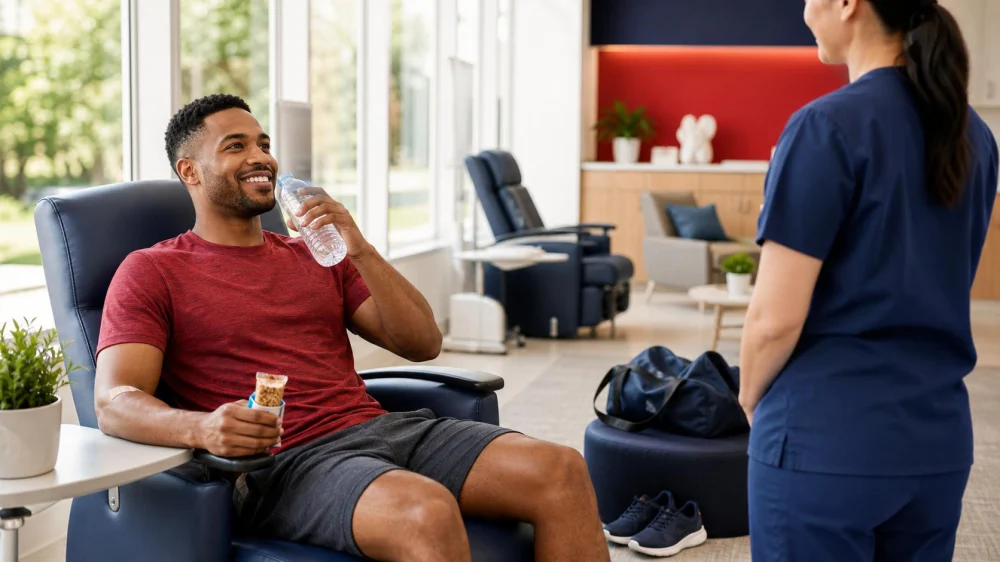
- Stay in the recovery area for the instructed time and leave only when staff say you are ready.
- Have the offered drink and snack or an appropriate alternative.
- Keep the bandage on and dry for the period in your instructions.
- Avoid strength training, running, intense intervals, contact practice, hot yoga, sauna use, and heavy carrying for the rest of the day.
- Avoid alcohol for the recommended period and drink the extra fluids advised by the center.
- If you feel lightheaded, stop, sit or lie down, and avoid driving, heights, water, machinery, or solo exercise.
If the needle site bleeds, follow the center’s pressure and arm-position instructions. Do not train through active bleeding, expanding bruising, arm pain, or weakness.
EōS Fitness / eos 19th and baseline
5910 W Baseline Rd, Laveen Village, AZ 85339, USA
Before you return
Check the donation center’s written timeline rather than using a gym friend’s routine. Confirm that you can stand, walk, climb stairs, eat, drink, and perform normal daily tasks without dizziness, unusual fatigue, shortness of breath, nausea, or renewed bleeding. Consider heat, altitude, competition, long endurance work, and exercises that load the donation arm.
People who donate frequently, have previously fainted, train for endurance events, take relevant medicines, have medical conditions, or do safety-sensitive work should ask the center or a health professional for a specific return plan. Do not self-prescribe iron solely to speed training recovery; discuss supplements and testing with a clinician.
Restart the workout
Make the first session easy to stop. Train with another person or near staff, choose a cool environment, and keep seated or supported options available. Start with a longer gentle warm-up. Reduce load, volume, pace, and interval length; leave several repetitions in reserve and avoid personal records.
Reassess after each block. Normal motivation is not proof that circulation, the needle site, and exercise tolerance have returned. If the warm-up feels unusually hard, switch to recovery activity or end the session. Resume normal training over subsequent sessions based on symptoms and the donation center’s instructions, not a fixed percentage.
Stop and get help
Stop immediately for faintness, dizziness, loss of coordination, unusual weakness, chest pain, severe shortness of breath, confusion, worsening headache, heavy bleeding, or rapidly increasing swelling at the needle site. Sit or lie down in a safe place and tell someone nearby.
Call emergency services for loss of consciousness, chest pain, breathing difficulty, stroke-like symptoms, uncontrolled bleeding, or another severe event. Contact the donation center using its aftercare number for donation-related problems, forgotten health information, or medical care after donation.
Return checklist
- Donation center instructions reviewed
- Rest-of-day vigorous exercise avoided
- Extra fluids, food, and bandage care completed
- No dizziness, unusual weakness, or active site bleeding
- Heat, altitude, sport, and fall risks considered
- First session reduced and easy to stop
- Training partner or staff support available when appropriate
- Donation center and emergency contact plan known
Limitations
This article is general guidance for an eligible donor after an uncomplicated donation. It cannot clear an individual for exercise or cover every donation type. Apheresis, frequent donation, pregnancy, anemia, heart or lung disease, medications, complications, and competitive demands require individualized direction.
FAQ
Can I lift weights later the same day?
The American Red Cross advises avoiding heavy lifting and vigorous exercise for the rest of the day. Follow your center’s instructions.
Can I walk home?
Ask the center and assess your route. Do not choose an activity where dizziness would leave you unsupported or at risk.
When can I do a hard run?
Use the center’s timeline and your symptoms. Return with an easier session first; competition or long endurance work may need more planning.
Should I take iron?
Do not start a supplement automatically. Frequent donors or people with iron concerns should discuss diet, testing, and supplements with a health professional.
What if I feel faint at the gym?
Stop, sit or lie down, tell someone, and follow the urgent-care rules above. Do not drive until you are safe to do so.
Evidence notes
The American Red Cross’s blood donation aftercare guidance advises extra fluids, avoiding alcohol for the stated period, and no heavy lifting or vigorous exercise for the rest of the day. It also tells donors with dizziness to stop and sit or lie down and provides an aftercare contact for problems. Follow the actual collector’s instructions when they differ.
Conclusion
A donated day is not the day to prove fitness. Protect the needle site, hydrate and eat as directed, avoid vigorous work, screen for symptoms, and make the first return session deliberately easy and reversible.

 Steam House Hot Yoga & Pilates5.0 (51 reviews)
 Yoga by Kumud5.0 (11 reviews)
 Empire Athletics4.0 (157 reviews)
 The Spa at Glenpointe4.0 (21 reviews)
 PDW Fitness0.0 (0 reviews)
 Retro Fitness4.0 (197 reviews)
 How to Keep a Workout Log That Actually Helps You Progress
 Beginner-Friendly HIIT Circuits You Can Do in a Small Apartment This Autumn – Stay Fit at Home
 Best Gym Machines for Beginners and How to Use Them | Hot Fitness
 Best Fall Outdoor Circuit Ideas That Use Benches, Stairs and Natural Terrain
 Advanced Techniques for Better CrossFit Results: Boost Your Performance
 How to Program Strength and Mobility to Fix Chronic Runner Pain Patterns Over 8 Weeks