
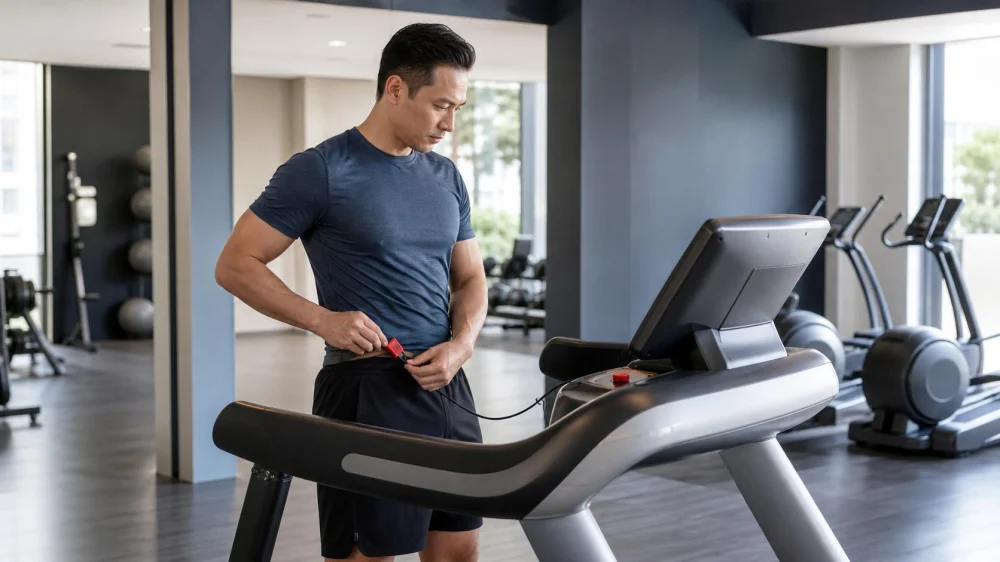
Treadmill Safety Clip: Start and Stop Checks
On this page
Quick answer
Before using a treadmill, identify the normal stop control and emergency safety key, confirm the clip and cord are intact, clear the belt and rear area, and follow the machine instructions. Attach the clip securely to clothing before starting at the lowest practical speed. Stop if the belt accelerates, hesitates, slips, or ignores a control. Report the exact machine and do not test a fault repeatedly.
This is general U.S. fitness-equipment guidance. Treadmill controls, clip placement, emergency procedures, user limits, and storage requirements vary by model and facility; the manual and gym instructions control.
HeartCore Pilates / heartcore pilates
ScottsdaleMaricopa CountyArizona
Pima and, E Happy Valley Rd, Scottsdale, AZ 85255, USA
What the safety key does
A treadmill safety key is a removable device connected to a cord and clothing clip on many motorized treadmills. When pulled from the console, it is intended to trigger an emergency stop. It is a backup control, not a guarantee against falling or contact with the moving belt.
The key must match the treadmill and seat correctly. The cord should be long enough for normal movement but positioned to pull the key if the user moves too far from the console. A clip attached to loose fabric, a waistband that can slip, or an object beside the treadmill may not work as intended.
Yogamaya / yogamaya ny
New YorkNew York CountyNew York
151 W 19th St 3rd floor, New York, NY 10011, USA
Before you step on
- Read the console labels and identify normal stop, emergency stop, and speed controls.
- Check the safety key, cord, and clip for cracks, fraying, weak grip, or a poor fit.
- Confirm the belt is clear and no object is under or behind the machine.
- Keep children, pets, exercise balls, bags, and loose equipment away from the treadmill area.
- Check that shoes are tied and clothing, towels, cords, and headphones cannot catch.
- Use the handrails and side foot rails as the manual directs for mounting and starting.
- Do not use a treadmill carrying an out-of-service notice or showing damage, unusual movement, or a power-cord problem.
At a shared gym, ask staff to demonstrate unfamiliar controls. Do not assume the key, quick-start button, pause function, or speed units match a treadmill you have used elsewhere.
Attach, start, and increase speed
- Stand in the starting position specified by the manufacturer, often on the side rails before the belt moves.
- Insert the correct safety key fully.
- Clip it securely to close-fitting clothing at the recommended location.
- Start at the machine's lowest practical speed and establish balance.
- Step onto the moving belt according to the instructions and look forward.
- Increase speed or incline gradually while maintaining control.
- Keep within the designed walking or running area rather than drifting close to the rear edge.
Do not jump onto a fast-moving belt, step off sideways while it is moving, or tie the safety cord around the wrist. If the clip repeatedly falls off during normal motion, stop and ask staff or the manufacturer to evaluate it.
Stop and step off
For a normal finish, reduce speed gradually, use the normal stop control, wait for the belt to stop completely, then step off with support as needed. Remove the key only as the instructions direct.
Use the emergency control when continued belt motion creates an immediate hazard. After an emergency stop, stay clear until all movement ends. Do not restart until the cause is understood and the user is ready.
If the safety key or stop control does not work as expected, end use, keep others away, and notify staff. A home treadmill should remain unplugged or otherwise secured according to its manual until qualified service addresses the issue.
Home and shared-gym checklist
At home:
- Follow required clearance around and behind the machine.
- Store the key away from the treadmill and out of children's reach when not in use if the manual instructs this.
- Check official recalls using the exact model and serial number.
- Keep the power cord, outlet, belt, deck, and maintenance schedule within manufacturer requirements.
In a shared gym:
- Choose another treadmill if the key is missing or damaged.
- Report belt hesitation, unexpected speed change, unusual noise, heat, smell, or display behaviour.
- Do not swap keys between machines or bypass a control.
- Respect staff closures and out-of-service tags.
Stop signs and limitations
Stop immediately for unexpected acceleration or stopping, belt slip, a sticking control, electrical sparking, smoke, burning smell, loose handrail, damaged deck, or a safety key that fails to trigger the expected response. Do not open motor covers or attempt a repair in a commercial gym.
Stop exercise for chest discomfort, faintness, dizziness, sudden pain, unusual shortness of breath, or another concerning symptom and seek appropriate medical help. A clip cannot compensate for an unsuitable workout, distraction, poor balance, or a health event.
Use extra caution when a clinician, medication, mobility condition, vision issue, or balance concern affects treadmill use. An alternative machine, supervision, or individualized professional guidance may be more appropriate.
Frequently asked questions
Do I need the clip for walking?
Use the safety system as the manufacturer and facility direct, regardless of speed. A loss of balance can occur during walking as well as running.
Can I hold the safety key in my hand?
No. Attach the clip to clothing at the instructed location so movement away from the console can pull the key. Holding it may prevent the backup from working.
Should I test the emergency stop before every workout?
Follow the manual or gym procedure. Do not create a fall risk by pulling it while moving, and do not repeatedly test a machine that behaves abnormally.
Why should the rear area stay clear?
A user or object can move off the back of the belt. Required clearance provides space and reduces entanglement or impact hazards. Use the exact distance stated by the manufacturer.
What if the treadmill changes speed unexpectedly?
Use the safest available stop method, move clear after the belt stops, and report the machine. Do not continue the workout or try to confirm the fault at higher speed.
Sources and evidence notes
This guide treats safety keys as backup controls and emphasizes clear space, model-specific instructions, and stopping abnormal equipment. The U.S. Consumer Product Safety Commission's recall database includes treadmill cases involving unexpected speed changes, stop-key failures, falls, and entrapment hazards. A past recall does not prove another treadmill is defective; match exact model information and use official current notices.
Next steps
Before the next treadmill session, locate the normal stop, emergency key, clip, and rear clearance. Attach the clip before starting slowly, and finish only after the belt stops. If any control or belt behaviour is uncertain, choose another machine and give staff the location and symptom.

 bodycraft studio5.0 (71 reviews)
 Metta Yoga5.0 (523 reviews)
 Anytime Fitness4.0 (77 reviews)
 Knight Fitness NJ5.0 (5 reviews)
 Aroma Spa & Sports LLC4.0 (267 reviews)
 Franklin High School Gym5.0 (3 reviews)
 How to Stay Motivated in Your Muscle Gain Journey: Expert Tips for Success
 How to Transition Your Meal Prep From Summer to Fall: Hearty, Recovery-Focused Recipes
 How to Stay Motivated in Your Cardio Workouts: Tips and Strategies
 The Best Muscle Gain Tips for Busy People: Quick and Effective Strategies
 The Power of +1: How Small Changes Can Make a Big Impact in Fitness and Life
 How to Use Short, Hard Over-Under Intervals to Build Toughness and Speed for 10K Races