
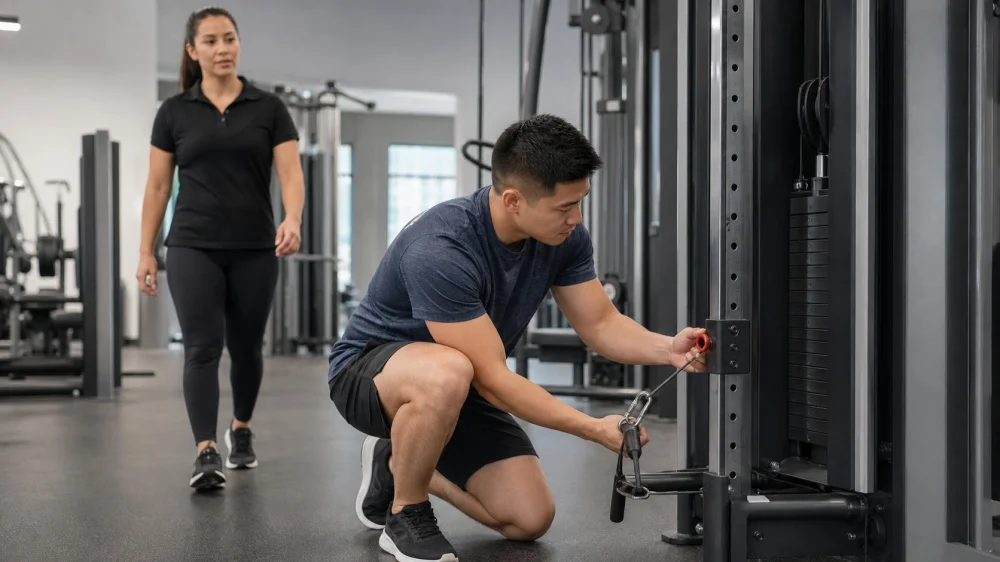
Gym Equipment Damage Check Before Every Set
On this page
Quick answer
Before each set, check that the equipment is stable, adjustment pins are fully engaged, cables and straps have no visible damage, pads and handles are secure, plates are loaded evenly, and the movement path is clear. If anything shifts, frays, bends, cracks, sticks, or sounds abnormal, stop. Keep others away and report the exact machine and condition to gym staff.
This guide is a quick user check for U.S. gyms and home fitness spaces. It does not replace the manufacturer's inspection schedule, qualified maintenance, facility procedures, coaching, or medical clearance for exercise.

Equinox Rockefeller Center / corepower yoga rockefeller center
New YorkNew York CountyNew York
45 Rockefeller Plaza, New York, NY 10111, USA
Why a user check matters
Fitness equipment changes between users. Someone may leave a selector pin partly inserted, move a bench without locking it, damage a cable, loosen an attachment, or place an object in the travel path. A brief check can catch an obvious problem before load is applied.
A user check is not a repair inspection. Internal wear, recalled parts, fastener torque, cable life, electronics, and structural faults require trained staff or authorized service. The user's job is to notice, stop, and report—not diagnose and improvise.
Studio Verve Pilates / studio verve
4545 N 36th St Suite 113, Phoenix, AZ 85018, USA
Ten-second pre-set scan
- Look around. Clear bottles, phones, bags, loose plates, and people from the movement path.
- Check stability. The bench, rack, platform, or machine should sit firmly without unexpected rocking.
- Check contact points. Handles, pads, footplates, seats, and grips should be attached and not visibly torn or slippery.
- Check adjustments. Pins, pop-pins, hooks, latches, stops, and seat settings must be fully seated.
- Check the load. Use matching plates where required, insert the selector pin fully, and secure plates with suitable collars.
- Check cables and straps. Stop for fraying, broken strands, kinks, cuts, loose ends, or a cable out of its pulley path.
- Test without working load. Move through a small controlled range when the equipment design permits. Stop for sticking, dropping, grinding, or unexpected motion.
Machine, bench, and free-weight checks
Selectorized and cable machines: confirm the pin belongs to the machine and passes fully through the intended plate. Check that adjustment pins engage, attachments close correctly, and cables remain aligned. Never use a substitute pin or carabiner.
Adjustable benches: verify the back and seat supports are locked into matching, stable positions. Look for a bent frame, cracked weld, loose pad, missing foot, or movement at the hinge.
Barbells and racks: check bar condition, rack height, J-cup and safety placement, plate balance, and collars. Use spotters or safety devices appropriate to the lift, load, equipment, and experience.
Dumbbells and kettlebells: stop for a loose head, cracked shell, damaged handle, leaking fill, sharp edge, or an unstable adjustable mechanism.
Cardio equipment: check the belt or pedals, handrails, emergency stop control, power cord location, and clear space. Mount and start at low speed according to the instructions.
What to do when something looks wrong
- End the set and unload only if that can be done safely.
- Keep other users from stepping into the hazard without creating a confrontation.
- Tell gym staff the equipment type, location, visible condition, and what happened.
- Use the facility's out-of-service tag or reporting system only as directed.
- Choose different equipment; do not test the problem repeatedly.
Do not tie a knot in a cable, tape a cracked handle, substitute hardware, tighten unknown fasteners, bypass a guard, or move an out-of-service label. A temporary-looking fix can conceal the fault from the next person.
Home-gym maintenance boundary
At home, record the brand, model, serial number, purchase information, assembly instructions, and maintenance schedule. Register the product when the manufacturer offers it and check official recall sources.
Perform only inspection and maintenance described in the manual with the correct parts and tools. Disconnect power and unload resistance as directed before service. Structural cracks, damaged cables, failing adjustment systems, electronics, or uncertain assembly warrant manufacturer or qualified technician support.
Do not modify equipment, drill new holes, add unapproved attachments, exceed rated loads, or mix parts from different systems unless the manufacturer explicitly approves the configuration.
Limitations and safety notes
A visual check cannot prove equipment is safe. Wear may be internal or difficult to see, and a machine can be subject to a recall even when it looks normal. Facilities need systematic inspection and preventive maintenance beyond user observations.
Stop exercise for sudden pain, dizziness, chest discomfort, faintness, unusual shortness of breath, or another concerning symptom and seek appropriate medical help. Equipment safety does not replace exercise technique, appropriate loading, gradual progression, or individualized clinical advice.
If equipment fails while someone is trapped or seriously injured, do not create a second hazard by moving heavy components without a plan. Alert staff and emergency services and follow trained directions.
Frequently asked questions
Is a frayed cable safe for one light set?
No. Stop using it and report the damage. Load can worsen a damaged cable suddenly, and a user cannot determine remaining capacity by appearance.
What if a selector pin does not fit smoothly?
Do not force or substitute it. Confirm the stack is aligned and ask staff to inspect the machine. A partially engaged or incorrect pin can release unexpectedly.
Can I tighten a loose gym bench?
In a commercial gym, report it rather than repairing facility equipment. At home, follow the manufacturer's manual and stop if the frame, weld, adjustment mechanism, or correct fastener is uncertain.
Should I photograph damaged equipment?
A photo can help identify the machine and defect if facility rules allow it and no other users are captured. Report the problem immediately rather than relying only on a message or photo.
Where can I check recalls?
Use the U.S. Consumer Product Safety Commission recall database and the manufacturer's official support page. Match the exact model and serial information.
Sources and evidence notes
This checklist emphasizes stopping for damaged pins, cables, benches, and attachments because these components can fail under load. The U.S. Consumer Product Safety Commission publishes product recalls; past fitness-equipment recalls have involved adjustment pins, dropping pulley carriages, benches, and other impact or entrapment hazards. A recall example supports the need to identify exact models, but it does not show that an unrelated machine is defective.
Next steps
Before your next set, build the ten-second scan into equipment setup: clear, stabilize, engage, inspect, load, and test. When a condition is uncertain, stop and report it with the machine location and visible symptom. In a home gym, add a monthly reminder to review the manual, maintenance record, and official recall information.


 bodycraft studio5.0 (71 reviews)
 Metta Yoga5.0 (523 reviews)
 Anytime Fitness4.0 (77 reviews)
 Knight Fitness NJ5.0 (5 reviews)
 Aroma Spa & Sports LLC4.0 (267 reviews)
 Franklin High School Gym5.0 (3 reviews)
 How to Stay Motivated in Your Muscle Gain Journey: Expert Tips for Success
 How to Transition Your Meal Prep From Summer to Fall: Hearty, Recovery-Focused Recipes
 How to Stay Motivated in Your Cardio Workouts: Tips and Strategies
 The Best Muscle Gain Tips for Busy People: Quick and Effective Strategies
 The Power of +1: How Small Changes Can Make a Big Impact in Fitness and Life
 How to Use Short, Hard Over-Under Intervals to Build Toughness and Speed for 10K Races