Weight Machines vs Free Weights: How to Choose at the Gym
On this page
Quick answer
Weight machines guide movement and simplify setup, while free weights allow more freedom and require you to control the path. Neither is universally better. Choose the option that fits your goal, current skill, joint comfort, available supervision, and equipment. Many people do well using both: a stable machine for focused work and a manageable free-weight exercise for coordination. Start light, learn the setup, and progress gradually.
BODYBAR Pilates / pilates morgantown wv
MorgantownMonongalia CountyWest Virginia
525 Suncrest Towne Centre Drive Suite 101, Morgantown, WV 26505, USA
What each option does well
Weight machines
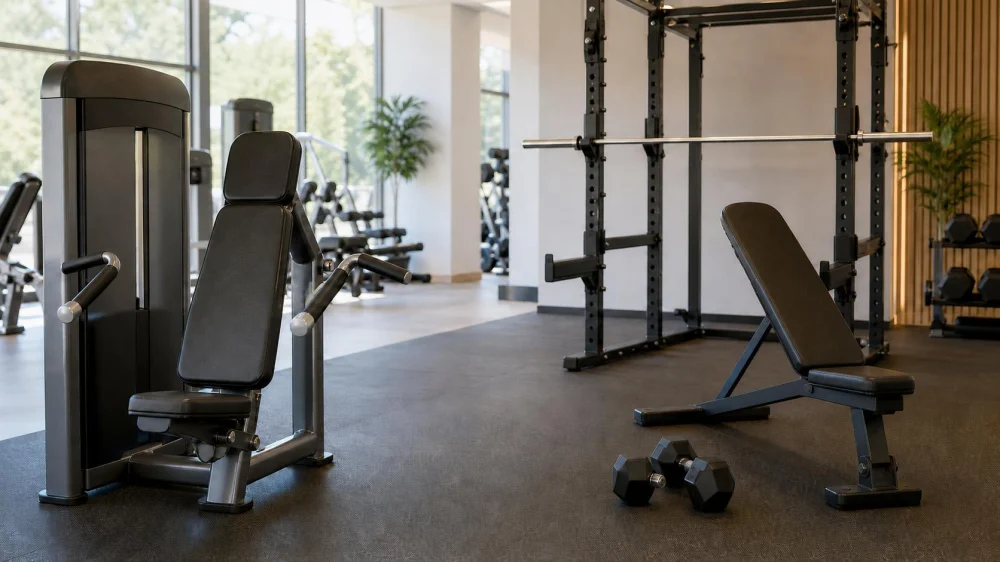
Selectorized and plate-loaded machines usually move along a fixed or constrained path. They can make it easier to adjust resistance, learn where to sit, and train a target movement without carrying weights across the gym. Machines can also be practical when balance, grip, or confidence limits a free-weight version.
But a fixed path is not automatically a perfect path for every body. Seat, pad, lever, and range settings matter, and some machines do not fit very short, tall, or differently proportioned users.
EōS Fitness / eos fitness baseline
5910 W Baseline Rd, Laveen Village, AZ 85339, USA
Free weights
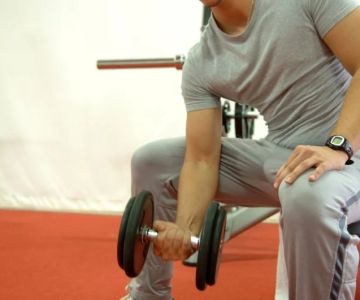
Dumbbells, barbells, kettlebells, and other free weights allow the user to choose the movement path. That flexibility can train coordination and make exercises adaptable, but it also increases the need for control, technique, space, and safe handling.
Free weights are not automatically more “functional,” and machines are not automatically safer. Exercise selection, load, fatigue, setup, environment, and the person using the equipment determine much of the risk and benefit.
Match the tool to your goal and ability
- New to resistance training: A well-fitted machine can reduce setup decisions, while light dumbbells can teach basic control. Use staff instruction for either.
- General strength: Both can create progressive resistance. Choose movements you can perform consistently through a comfortable range.
- Muscle-focused training: Machines can reduce balance demands; free weights offer many angles and variations. Total training, recovery, and progression matter more than the label.
- Sport or job preparation: Select exercises that reflect the strength, speed, range, and coordination needed, ideally with qualified programming.
- Limited balance or mobility: Supported machines may help, but fit and transfers must be safe. Adaptive equipment or professional guidance may be appropriate.
- Training alone: Favor exercises with a controllable exit and avoid heavy lifts that can trap you without safeties or a competent spotter.
The CDC guidance for adults with chronic conditions or disabilities lists exercise bands, weight machines, and handheld weights as possible muscle-strengthening options, while advising consultation about appropriate activity.
Set up weight machines carefully
- Read the diagram and inspect the machine. Do not use damaged cables, loose pads, missing pins, or unstable parts.
- Adjust the seat and pads. Align the machine's pivot with the joint indicated by its instructions where applicable.
- Select a light starting resistance. Confirm the pin is fully inserted and no loose item is near moving parts.
- Test the range. Move slowly through a comfortable path without being forced into an extreme position.
- Keep contact points stable. Follow the back, foot, hand, and pad placement shown for that machine.
- Control both directions. Do not let the weight stack slam or bounce.
- Exit only after the load rests. Keep hands clear of plates, pulleys, and pinch points.
If the machine cannot be adjusted to fit you without discomfort, choose another exercise. Do not improvise pads, stand on unstable objects, or alter safety stops.
Use free weights with control
- Choose a clear area with stable flooring and enough space for the implement.
- Begin with a load you can pick up, position, move, and return without momentum or assistance.
- Use collars, rack safeties, and a bench according to equipment instructions.
- Keep weights away from walkway edges and re-rack them after use.
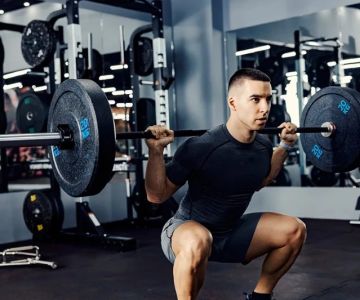
- For barbell lifts, set safety arms at an appropriate height and learn how to exit a failed repetition.
- Use a competent spotter when the lift and load call for one; a spotter is not a substitute for safeties or manageable weight.
- Stop the set when technique becomes uncontrolled.
Ask qualified gym staff or a credentialed trainer to demonstrate unfamiliar equipment. Online clips cannot evaluate your anatomy, symptoms, or actual technique.
Build a simple mixed session
A balanced beginner session can use a few movement categories rather than every machine in the room. For example:
- A machine squat or supported leg press, or a light goblet squat
- A seated row machine or a supported one-arm dumbbell row
- A chest press machine or an elevated dumbbell press
- A machine hamstring exercise or a light controlled hip-hinge variation
- A carry, trunk-stability, or balance exercise appropriate to the person
This is a category example, not a prescription. Exercise order, sets, repetitions, and load should match training history, health, recovery, and goals. You do not need both versions of every movement in one session.
Progress without rushing the load
Keep the exercise, equipment, and range consistent long enough to judge progress. When all planned repetitions are controlled and the effort is manageable across more than one session, consider a small change such as one additional rep or the smallest available resistance increase.
The CDC advises beginners to start slowly and work toward longer or more challenging activity. Large jumps create a bigger gap between current ability and new demand. Change one variable at a time and allow recovery before judging the result.
Do not compare the number on one machine with a different machine or a free-weight load. Pulley systems, lever arms, friction, starting positions, and calibration differ.
Safety, symptoms, and professional help
This is general adult fitness education, not individualized medical care or training. People with chronic conditions, disabilities, pregnancy, recent surgery, an injury, or a long period of inactivity should ask a qualified health professional about suitable types and amounts of activity. A physical therapist or credentialed exercise professional may help adapt movement.
Stop and seek urgent medical help for chest pain or pressure, fainting, severe breathing difficulty, or sudden neurologic symptoms. Stop the exercise for sharp pain, joint instability, new numbness, or a technique breakdown you cannot correct. Do not train through worsening symptoms merely because a machine guides the motion.
Inspect equipment, use closed-toe footwear, keep children away from weights, and follow the facility's current rules.
Frequently asked questions
Are machines better for beginners?
They can simplify setup and reduce balance demands, but they still require correct adjustment and control. Some beginners learn well with light free weights under instruction.
Can machines build strength?
Yes. Machines can provide resistance that is progressed over time. The best choice depends on the strength goal and whether it transfers to the task you care about.
Do free weights burn more calories?
Calorie use varies with exercise, load, duration, rest, body size, and many other factors. Do not choose equipment based on a universal calorie claim.
Should I use the same weight on every machine?
No. Machine mechanics differ, and muscle groups have different capacities. Select resistance separately based on controlled performance and effort.
Can I switch between machines and free weights each week?
You can, but frequent changes make progress harder to compare. Keep a core group of exercises consistent and add variety deliberately.
Conclusion and decision checklist
Choose machines when guided movement, easy adjustment, or extra support helps; choose free weights when adaptable movement and active control suit the goal. Confirm fit, learn safe setup, start light, and progress in small steps. A mixed plan often works well, but the best equipment is the one you can use correctly, consistently, and without alarming symptoms.
 REBELFIT BOXING ACADEMY4.0 (5 reviews)
 Lotus Yoga4.0 (10 reviews)
 Powerhouse Gym Troy4.0 (403 reviews)
 Train Your Inner Athlete5.0 (10 reviews)
 The Gym LA4.0 (144 reviews)
 Yogarok5.0 (6 reviews)
 How to Choose a Group Fitness Class That Fits You
 How to Program Strength Cycles Around Your Biggest Racing Goal in Autumn for Optimal Results
 Strength Moves to Improve Stability and Reduce Risk of Ankle Sprains on Trails
 Best Fall Outdoor Circuit Ideas Using Benches, Stairs, and Natural Terrain
 How to Build a Weekly Template That Prioritizes Recovery During Heavy Training Blocks
 How to Train for a Tough, Windy Fall 10K: Pacing, Strength & Mental Tricks