
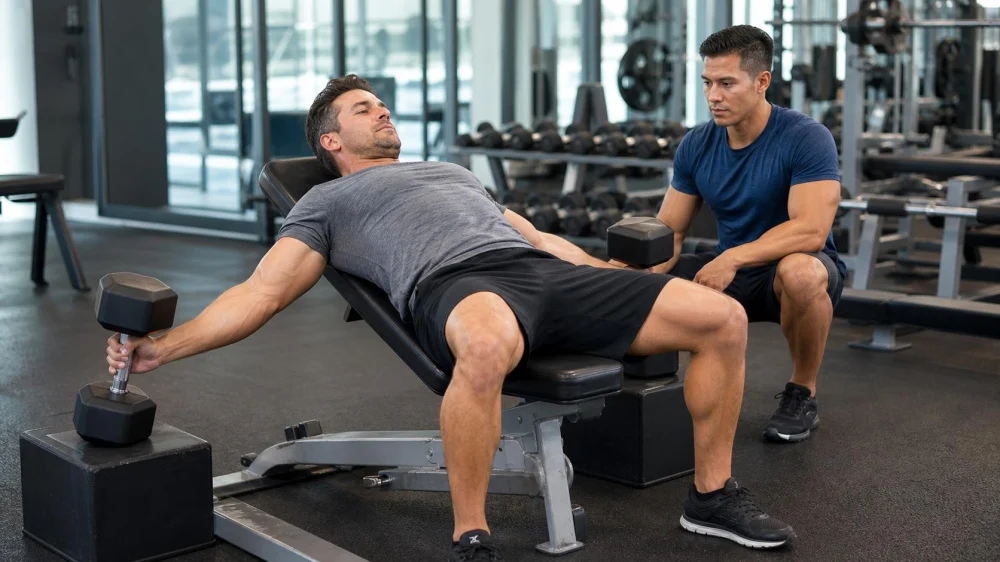
Training to Failure: Use It Selectively, Not Every Set
On this page
Quick answer
Most healthy adults do not need to take every resistance-training set to momentary failure to make progress. Working close enough that the final repetitions are challenging can provide a useful training stimulus with less form breakdown and fatigue. Reserve true failure for selected, stable exercises and planned sets, use safeties or a competent spotter, and stop for pain, dizziness, or loss of control.
This guide is for generally healthy adults in the United States with basic resistance-training experience. It is not a medical clearance or a rehabilitation plan. People with cardiovascular, neurological, metabolic, joint, pregnancy-related, recent surgery, or other health considerations should follow advice from an appropriately qualified clinician and fitness professional.

Deep Creek Fitness / deep creek fitness
24586 Garrett Hwy, McHenry, MD 21541, USA
What training to failure means
Momentary muscular failure is the point in a set when you cannot complete another full repetition with the intended technique despite trying. It is different from choosing to stop because the set feels difficult, and it is different from continuing with shortened range, altered body position, bouncing, or help from another muscle group.
Technical failure is the point at which the next repetition would require a meaningful breakdown in the planned technique. For many gym situations, technical failure is the more practical stopping boundary because it protects the exercise pattern before the weight becomes uncontrolled.
Repetitions in reserve, often shortened to RIR, is an estimate of how many good repetitions you could still perform at the end of a set. Stopping with one or more repetitions in reserve is non-failure training. The estimate improves with experience but remains subjective, especially for beginners and unfamiliar exercises.
Failure is therefore not a single visible facial expression or level of discomfort. It is specific to the load, exercise, range of motion, technique standard, and person performing the set.

PWRBLD Gym Warrington / gym in warrington
WarringtonBucks CountyPennsylvania
1661 Easton Rd Unit C-1, Warrington, PA 18976, USA
Potential benefits and tradeoffs
Training close to failure can help ensure that a set is challenging enough, particularly with moderate or lighter loads. An occasional controlled failure set may also teach an experienced lifter how an RIR estimate feels on a stable exercise.
But taking a set to failure generally creates more immediate fatigue than stopping earlier. That can affect later sets, other exercises, technique, recovery, and willingness to train consistently. The tradeoff matters when the workout includes complex lifts, many sets, high weekly volume, or sport practice.
Failure is best considered when:
- the exercise is stable and the weight can be stopped or released safely;
- the lifter has practiced consistent technique and understands the stopping point;
- the set is late in the exercise or session rather than compromising all later work;
- the program intentionally manages the added fatigue; and
- a spotter, machine stop, rack safety, or other appropriate control is available when needed.
It is not ideal as an automatic rule for every exercise, every set, every training day, or every person. Effort is one programming variable alongside load, repetitions, sets, rest, frequency, exercise selection, movement quality, and recovery.
A decision checklist for each exercise
Before deciding how close to failure to train, ask:
- What happens if the next repetition fails? A machine handle returning to its stop differs from a bar becoming trapped over the body.
- Can I keep the intended range and position? Stop at technical failure if the next rep requires bouncing, twisting, shortening, or losing joint control.
- Is the setup stable? Confirm pins, cables, collars, benches, safeties, and floor space before loading.
- Do I have a safe exit? Know how to rack, lower, or stop the weight. Do not invent a bailout during the final repetition.
- How important are later sets? Early failure may reduce the quality or amount of planned work that follows.
- What did recent training show? Poor sleep, illness, heat, unusual soreness, or a prior hard session may justify leaving more repetitions in reserve.
- Is effort the goal or is skill the goal? Learning a movement generally benefits from repeatable technique rather than exhaustion-driven practice.
- Is there pain or a warning symptom? Pain, dizziness, faintness, chest pressure, unusual shortness of breath, loss of coordination, or sudden weakness is a stop signal, not a cue to push harder.
How to use proximity to failure safely
Start conservatively. Choose a load you can control through the intended range and stop with several repetitions in reserve while learning. Increase effort only after the setup and technique are consistent.
Define the repetition standard. Decide the range, tempo, body position, and allowable pause before the set. When the standard changes, the set has reached its practical endpoint even if the weight still moves.
Use appropriate equipment. Set rack safeties to protect the body without interfering with the lift. Learn the machine stop and seat adjustments. For dumbbells, plan how they will return to a stable surface without dropping them into another person’s space.
Communicate with a spotter. Agree on when help begins, whether a lift-off is needed, and the target repetitions. A spotter should not turn every repetition into an assisted repetition or grab unpredictably.
Limit failure exposure. If failure has a clear purpose, consider applying it to a selected final set or low-consequence exercise rather than the whole workout. Record the exercise, load, repetitions, estimated RIR, technique, and effect on later work.
Progress with several options. Improvements can come from better technique, more controlled repetitions at the same load, a modest load increase, an added set, or improved weekly consistency. Failure is not the only sign of productive training.
When to avoid failure training
- when you are new to the movement or cannot judge technical breakdown;
- when a failed repetition could trap, drop, or accelerate a load dangerously;
- during explosive, high-skill, or speed-focused work where fatigue changes the task;
- when training alone without suitable safeties or a safe stopping mechanism;
- when pain, illness, dehydration, heat stress, dizziness, or unusual fatigue is present;
- when a clinician or rehabilitation professional has set a different boundary;
- when repeated failure is reducing performance, technique, sleep, motivation, or recovery; or
- when gym crowding makes controlled exits and spotting unreliable.
Stop exercise and seek urgent medical evaluation for chest pain or pressure, fainting, severe breathing difficulty, new neurological symptoms, or another potentially serious event. In the United States, call 911 for a life-threatening emergency.
Evidence and limitations
Systematic reviews comparing failure and non-failure resistance training in healthy adults generally do not support a need for every set to reach failure for strength or muscle gains. Results depend on how failure is defined, whether training volume is matched, participant experience, exercise selection, and study design.
The current American College of Sports Medicine position stand on resistance training synthesizes broad evidence and reports that training to fatigue or momentary failure does not consistently change outcomes for the average healthy adult. That population-level conclusion is not an individual prescription and does not cover every athletic, clinical, or rehabilitation goal.
RIR and technical-failure judgments are estimates. A qualified strength professional can observe technique and design progression, while a clinician can address symptoms and medical restrictions.
Frequently asked questions
Do I have to feel a burn for a set to work?
No. Burning sensations vary with exercise, repetition duration, load, and individual response. Progress is better evaluated through repeatable performance, technique, training records, and recovery.
Is technical failure the same as muscular failure?
No. Technical failure occurs when the planned movement standard can no longer be maintained. Muscular failure is inability to complete another full repetition despite attempting it. Stopping at technical failure is often the safer practical choice.
Are machines safer for failure training?
Some machines provide a more stable path and controlled stop, but setup, pinch points, range, seat position, and equipment condition still matter. “Machine” does not automatically mean risk-free.
Can beginners train to failure?
Beginners usually benefit from learning technique, equipment setup, and effort judgment with repetitions left in reserve. A qualified coach can decide when a controlled exposure is useful.
How accurate is reps in reserve?
Accuracy varies and often improves with practice. Estimates can change across exercises, loads, sleep, and fatigue. Use RIR as one log field, not a precise biological measurement.
Should the last set always go to failure?
No. The last set may be a reasonable place for selected use, but exercise safety, program goals, fatigue, and recovery still control the decision. There is no universal last-set rule.
Next steps
Choose one stable exercise, define good-repetition technique, set up a safe stopping method, and end sets before form changes. Log estimated repetitions in reserve and how the effort affects later work. Use true failure only when it has a clear purpose and low-consequence setup, and seek professional guidance for health conditions, pain, or uncertainty about technique.




 Vernon Lee Gymnastics Academy3.0 (27 reviews)
 VASA Fitness4.0 (1654 reviews)
![[solidcore] Coral Gables](https://img.hotfitness.net/d29/2509/15532923763736_150x150.webp) [solidcore] Coral Gables3.0 (15 reviews)
[solidcore] Coral Gables3.0 (15 reviews) Patriot Fitness 24/75.0 (67 reviews)
 Fighting Comes First5.0 (18 reviews)
 Body & Brain Yoga Tai Chi5.0 (102 reviews)
 The Best Strength and Conditioning Drills for High School Athletes Heading Into Fall Sports
 Best Resistance Band Exercises for Shoulder Health and Pulling Strength This Autumn
 Science-Backed Tips for Improving Your Yoga Practice | Hot Fitness
 How to Build Stronger Glutes for Running Power, Speed, and Injury Prevention
 The Best Muscle Gain Tips for Busy People: Quick and Effective Strategies
 How to Increase Workout Results with Proper Form