
Gym Floor Space: Set Up Without Blocking or Collisions
On this page
Quick answer
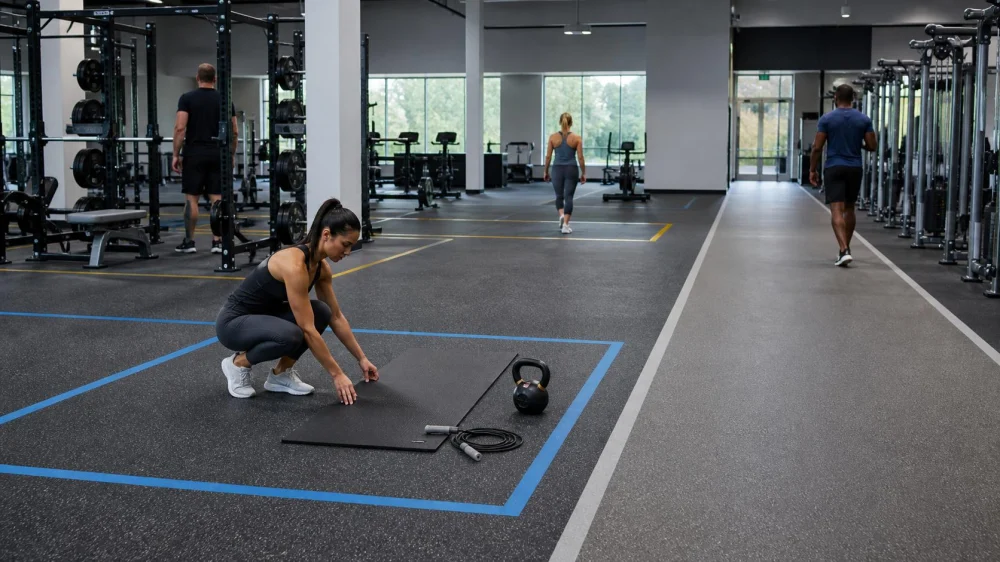
Choose a gym zone intended for the exercise, then account for your body, equipment, range of motion, possible loss of balance, and other members’ travel paths. Keep exits, accessible routes, racks, mirrors, cable lanes, and emergency equipment clear. Place unused items together outside the movement area, orient swings and throws away from people, and reset the space before every set.
If the room is too crowded for the full movement footprint, wait, reduce the setup, or move to another approved area.
StretchLab / stretchlab fairfield
FairfieldGreater Bridgeport Planning RegionConnecticut
85 Mill Plain Rd, Fairfield, CT 06824, USA
Choose the right zone
- Use platforms for approved barbell work.
- Use functional turf or open training areas for carries and sleds.
- Use mat zones for floor work when provided.
- Keep kettlebell swings out of walkways and rack access.
- Keep jump ropes away from lights, mirrors, and other users.
- Follow marked lanes and class boundaries.
- Ask staff where unfamiliar equipment belongs.
Open-looking floor may still be a circulation route or required clearance. Do not move signs, barriers, or accessibility equipment.
South Chandler Fit Body Boot Camp / south chandler fit body boot camp
ChandlerMaricopa CountyArizona
25410 S Arizona Ave suite 186, Chandler, AZ 85248, USA
Map the full footprint
Stand in the intended position without weight and rehearse the range slowly. Include overhead reach, arm and leg extension, rotation, stepping, equipment swing, and the space needed to set down safely. Add a buffer for a missed repetition or an unexpected person.
Look in every direction, including behind you and above. Mirrors can distort distance and do not reveal someone approaching from a blind corner.
Place equipment deliberately
- Bring only the items required for the set.
- Put bottles, phones, towels, and bags in the facility’s storage location.
- Position plates and dumbbells flat or in approved holders.
- Keep resistance bands, straps, and ropes coiled outside walking paths.
- Set benches squarely with all feet stable.
- Route cable attachments within the machine’s intended lane.
- Return unused equipment before adding another station.
Do not use a loose plate, foam roller, or dumbbell as a doorstop, marker, or prop unless it is designed for that purpose.
Coordinate with people nearby
Make brief eye contact and state your intended movement when paths may overlap. Do not assume headphones mean someone sees you. Wait for a person to finish a set before walking through their range or reaching for equipment beside them.
In pairs or groups, define where the active person moves and where others wait. Spectators should remain outside the buffer, not directly behind a lifter or beside a swinging weight.
Reset between sets
Fatigue, moved benches, rolling weights, wet spots, and new traffic can change a safe setup. Before each set, scan the floor, re-center equipment, confirm clear overhead space, and check that nobody has entered the lane.
Wipe sweat promptly using facility supplies and mark or guard a slippery area until staff can address it. Return clips, attachments, mats, and small items rather than leaving them for the next person.
When to stop or move
Stop when a class expands into the area, a cleaner or technician needs access, a child or visitor enters the lane, equipment shifts, lighting fails, or the floor becomes wet or damaged. Follow staff directions even if the set is incomplete.
Also stop if you feel pain, dizziness, faintness, confusion, or loss of control. Sit or lie in a safe location and seek appropriate assistance rather than crossing the room with equipment.
Frequently asked questions
How much space does a kettlebell swing need?
Enough for the full path, a controlled set-down, and a buffer. Use the facility’s designated area and staff guidance.
Can I exercise in front of a dumbbell rack?
No. Move away so others can select and return weights safely.
Is a hallway okay for loaded carries?
Only if the gym designates it and the route remains controlled and unobstructed.
Where should my phone and bottle go?
Use a holder, cubby, or edge outside the movement and walking zones.
What if someone walks into my setup?
Stop the movement safely, reset, and communicate before resuming.
Sources and evidence notes
This guide applies collision prevention, housekeeping, circulation, equipment-control, and shared-space principles. Required clearances vary by exercise, facility layout, equipment manufacturer, accessibility obligations, and emergency plan.
Follow gym rules, staff direction, posted markings, and equipment instructions. Choose a smaller or different setup whenever the full movement cannot be controlled.
Conclusion and next steps
Before the first repetition, identify the approved zone, rehearse the full movement, add a buffer, and remove loose items. Treat every rest period as a chance to scan and reset because people and equipment move. A clear training footprint protects the exercise, the route around it, and every person sharing the floor.


 Steeltown Athletics5.0 (10 reviews)
 The Rec Auburn Teen Center4.0 (8 reviews)
 Paxson Yoga and Wellness Center4.0 (15 reviews)
 Heatwise4.0 (43 reviews)
 Jodi Stern Pilates5.0 (8 reviews)
 Renee Packer Pediatric Physical Therapy LLC5.0 (1 reviews)
 How to Incorporate Weight Loss Into Your Day
 Top 5 Myths About Fitness You Need to Stop Believing
 How to Use Short Intervals to Build Speed Without Sacrificing Aerobic Base This Season
 The Best Beginner Workout Plan for Men – Step-by-Step Guide
 The Benefits of Daily Workout – Boost Your Health, Fitness, and Wellbeing
 Best Fall Outdoor Circuit Ideas Using Benches, Stairs, and Natural Terrain