
Dumbbell Rack Safety: Lift, Carry, and Return Weights
On this page
Quick answer
Check the dumbbell, rack, floor, and route before lifting. Choose a load you can control from the rack to the exercise area, use two trips rather than carrying too much, keep weights close to your body, and set them down without dropping. Return each dumbbell to its labeled cradle with fingers clear and do not leave weights where they create trip or rolling hazards.
Follow the gym’s floor, dropping, chalk, and equipment-zone rules. Ask staff for help when a rack is crowded, unstable, damaged, or outside comfortable reach.
Down Dog Yoga Georgetown / downward dog yoga georgetown
WashingtonDistrict of Columbia
1229 34th St NW, Washington, DC 20007, USA
Before taking a dumbbell
- Confirm the weight and match the pair.
- Inspect handles, heads, end caps, coating, and fasteners visually.
- Check that the rack cradle supports the full dumbbell.
- Clear bottles, phones, plates, and bags from the floor.
- Plan the route around benches, mirrors, and people.
- Keep closed-toe footwear secure and laces tied.
- Warm up with a lighter load before the working set.
Do not use a dumbbell with a loose head, rotating end, split coating, sharp edge, or bent handle. Place it out of use only as staff directs and report it immediately.
Crunch Fitness - Worcester / crunch fitness - worcester east
WorcesterWorcester CountyMassachusetts
40 Millbrook St, Worcester, MA 01606, USA
Remove weights safely
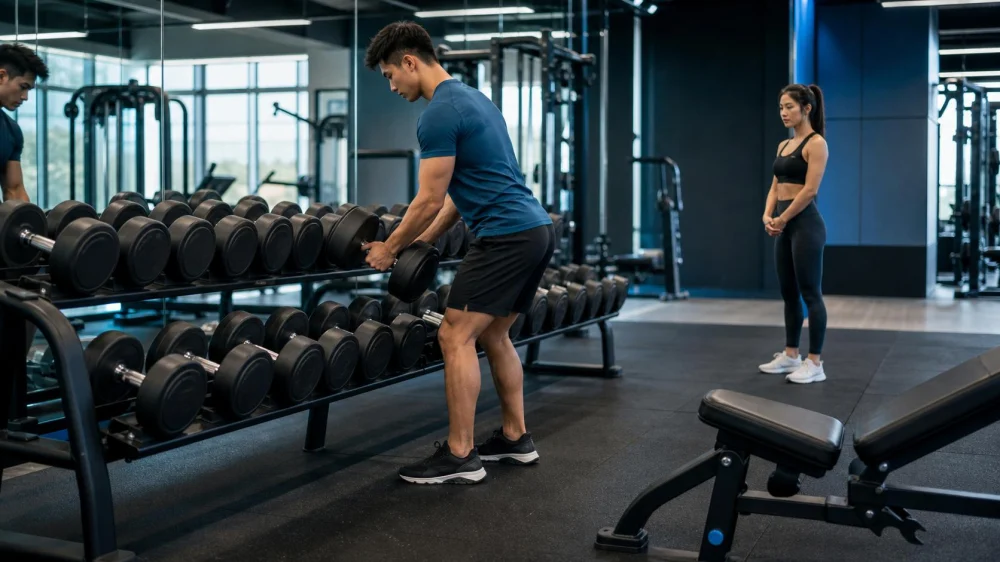
Stand squarely in front of the selected cradle without reaching across another member. Use a stable grip, brace your body, and lift the dumbbell clear before turning. For a low rack, bend through hips and knees as appropriate rather than rounding and twisting under load.
For a high or tightly nested rack, ask staff for assistance. Never climb on a rack, pull one dumbbell out from beneath another, or use a heavier weight as a step or lever.
Carry to the training area
- Hold one weight in each hand only if both can be controlled comfortably.
- Keep arms close and maintain a clear view of the floor.
- Walk—do not rush—around benches and cable paths.
- Give moving lifters extra room.
- Use two trips for multiple pairs or long routes.
- Place weights in the designated zone before adjusting a bench.
Do not carry a dumbbell on a shoulder in a crowded room or balance it on a bench while moving equipment.
Set down and return
Lower dumbbells under control to a stable floor area where they cannot roll. Use rubberized lifting zones when the exercise and gym rules permit contact with the floor. Do not drop light weights simply because heavier lifting occurs nearby.
At the rack, align the dumbbell with its matching labeled cradle, keep fingertips outside pinch points, and confirm it is seated before releasing. If the correct space is occupied by the wrong weight, ask staff or reorganize only loads you can handle safely.
Work around other members
Do not exercise directly in front of the rack or block access while resting. Move far enough away that others can select weights without stepping through your set. Avoid standing behind someone who is lifting from a lower tier.
When a pair is in demand, state how many sets remain and offer to alternate only when load changes and space can be managed safely. Wipe handles according to facility hygiene rules.
Damaged equipment
Stop using a rack that rocks, has a bent cradle, missing fastener, sharp metal, or loose anchor. Keep people away and notify staff. Do not tighten hardware, tape a dumbbell, or improvise a wedge.
Report a dropped weight that struck a person, floor, mirror, bench, or other equipment even when damage is not obvious. Follow staff incident procedures.
Frequently asked questions
Should I carry several dumbbells at once?
Use separate trips rather than reducing grip, visibility, or control.
Can I leave dumbbells beside my bench?
Keep them in the designated area and out of walking paths. Return them when finished.
Why not work directly at the rack?
It blocks access and places other members near moving weights.
Can I drop dumbbells after a set?
Follow the gym’s rules and control the load. Unplanned dropping can injure people and damage equipment.
What if a dumbbell label is missing?
Ask staff to identify it rather than guessing or pairing mismatched loads.
Sources and evidence notes
This guide applies ordinary material-handling, pinch-point, trip-prevention, shared-space, and equipment-inspection principles to a gym setting. Safe load and technique depend on the individual, exercise, equipment, and facility rules.
Use gym staff instruction and the equipment manufacturer’s guidance. Stop if pain, dizziness, or loss of control occurs and seek appropriate help.
Conclusion and next steps
Treat the route between rack and exercise area as part of every set. Inspect the pair, lift without twisting, carry only what you can see and control, and keep weights out of traffic. Return each dumbbell fully into the correct cradle with fingers clear, then report damage instead of leaving the next member to discover it.


 Steeltown Athletics5.0 (10 reviews)
 The Rec Auburn Teen Center4.0 (8 reviews)
 Paxson Yoga and Wellness Center4.0 (15 reviews)
 Heatwise4.0 (43 reviews)
 Jodi Stern Pilates5.0 (8 reviews)
 Renee Packer Pediatric Physical Therapy LLC5.0 (1 reviews)
 How to Incorporate Weight Loss Into Your Day
 Top 5 Myths About Fitness You Need to Stop Believing
 How to Use Short Intervals to Build Speed Without Sacrificing Aerobic Base This Season
 The Best Beginner Workout Plan for Men – Step-by-Step Guide
 The Benefits of Daily Workout – Boost Your Health, Fitness, and Wellbeing
 Best Fall Outdoor Circuit Ideas Using Benches, Stairs, and Natural Terrain